We left Aqaba on May 24th for a short five-day Egypt detour to spend a little beach time and enjoy some R&R. We took the late ferry from Aqaba to Nuweiba—an adventure in itself, as you’ll discover below—and then a taxi to Dahab.
Dahab was not what we expected. We had a hotel reservation, so we slept for a few hours and then headed farther south to Sharm El-Sheikh, a tourist resort town near the southern tip of the Sinai Peninsula.
We stayed at a nice little hotel on the beach at Naama Bay. Joyce was thrilled that she could wear her two-piece and relax on the beach. The water was incredibly clear, and we essentially had our own aquarium to snorkel in just metres from shore.
Tourism had declined sharply following the October 2015 Metrojet attack. While we were there, news arrived that a busload of Coptic Christians had been murdered by ISIS in Egypt. It was hard to imagine what the area had been like in its heyday, but we could feel the sense of desperation among the shopkeepers and the bar and restaurant operators.


The Late Ferry to Nuweiba: An Adventure
We were advised to arrive at the ferry terminal three hours before departure to clear customs formalities. With Ramadan only a few days away, there would also be many Egyptian workers travelling home from Jordan to be with their families.
We arrived to chaos.
Hundreds upon hundreds of mostly men were lined up with an unimaginable array of giant boxes, crates and parcels waiting to be X-rayed. There was only one small entrance into the terminal.
Within minutes, a Jordanian tourist police officer approached us, told us to put our packs onto the X-ray scanner belt and then escorted Joyce through a side door into the terminal. I was left waiting more than 15 minutes for our packs while Joyce stood on the other side—a lone white foreign woman among hundreds of Arab men in a room reminiscent of a Turkish prison holding cell.
Inside was a long line leading to a single hole-in-the-wall window where passengers had to pay a 10 JD departure tax. The tourist policeman told Joyce to go to the front of the line. Being the polite Canadian, she refused, so she was directed to stand in a corner of the cavernous room filled with gawking Bedouin and Arab men.
I finally retrieved our bags and was led through the side door, bypassing the sweating masses waiting in line. We took a seat, not really knowing what to do next. Then two other white foreigners from Canada arrived and were immediately directed to join Joyce and me.
After a short introduction—and a unanimous admission that all four of us were clueless—we were led to the front of the departure-tax line and processed immediately.
The next step, which I can honestly say we would never have known about without the tourist policeman, was to stand in another line to have our passports processed. Again, we were led to the front, to the consternation, I believe, of those already waiting.
We were then directed to the front door of the boarding area and, within minutes, escorted onto the ferry. Four white tourists trying to look innocent in front of hundreds upon hundreds of other passengers who had waited patiently in their places in line.
As tourists, we received royal treatment. As the only foreigners on the ferry, we were truly grateful for the way the tourist police treated and assisted us. We are fairly adept travellers, but we couldn’t imagine navigating the process without their help, particularly because of the language barrier. There were no signs in English, and every announcement was in Arabic.
This was not a tourist-oriented ferry and, as you can probably guess, the story doesn’t end here.
We boarded at around 8:45 pm, only 45 minutes after arriving and probably two hours before the rest of the passengers began boarding.
Oliver and Emily were the other two Canadians, a young brother and sister from Montreal. We sat together, marvelled at the treatment we had received and joked that it would be wonderful if the same policeman met us at the other end.
Not likely…
At around 11:50 pm, the ferry finally left port, about 50 minutes late. We had already been aboard for roughly three hours before the three-hour journey even began.
Jump forward three hours. The ferry had docked in Nuweiba, but nothing happened. People were still sleeping and talking, and nobody seemed to be in any hurry to leave. We didn’t know the process, where to exit or when to exit, so we sat tight.
Then two uniformed men approached from my right. One serious-looking dude said, “Mister, where are you from?”
“Canada,” I answered.
“Passports, please. Follow me.”
Okay, now what?
We followed him through the seating area, down the stairs and toward the ship’s exit. Unbelievable—first on, first off! A repeat of our boarding process. How about that!
Not so fast.
We followed the man, who looked like the main jail guard from the movie Midnight Express—one slightly narrowed eye and a slight smirk on his face. We walked quickly through a labyrinth of very long hallways and corridors in the giant ferry terminal before eventually stopping at a row of customs booths.
This was amazing: the same treatment we had received on departure.
The customs officer checked our passports. A few minutes later, our “escort” seemed to pop out from behind the booth with our passports in his hands. Once again, we were directed to follow him on a very long hike through the terminal. There was not another person in sight. It was a huge building, and it was difficult to imagine how many people the place could handle.
It was now close to 3:00 am.
We continued following El Capitan through the cavernous terminal until we reached a small office door. He unlocked it and told us to wait inside his office. We went in, sat down and waited.
For what?
We were told that our passports had to be checked through a global passport-checking system. As soon as he heard from his manager that everything was okay, we could leave.
Okay. It shouldn’t take long. Nothing to hide.
He sat behind his desk, opened his Dell computer, played Arabic music and scrolled through Facebook, all the while cracking a small smile and looking at us through his slightly narrowed eye.
Hmmm…
We waited. And waited. And waited.
Were we being detained? We didn’t know. He left the office—and left our passports on his desk. We all looked at one another.
Do we run for it?
Not a good idea.
Finally, after about an hour, we were just asking him to contact his manager in case he had forgotten about us—and reminding him that we did have a ride waiting—when his walkie-talkie crackled.
“Okay,” he said.
But it wasn’t quite over.
He still had our passports, and we again followed him through the hallways and corridors until we reached the outside. The exit gate was still 200 metres away. On our right was an armoured vehicle with a mounted machine gun, manned by an Egyptian soldier. At the gate stood a guard armed with an Uzi.
We reached the gate, but our escort still had our passports. He continued walking with us until we arrived at our waiting taxi. Our passports were finally handed over, we shook hands, and off we went to Dahab—arriving at sunrise, around 5:00 am, ten hours after we had first reached the ferry terminal.
It was a great adventure, and the authorities made sure that, as tourists, we avoided the very real hassles we would almost certainly have encountered without their assistance. When we left the terminal, about two hours after arriving, the masses from the ferry still had not made their way to the exits.
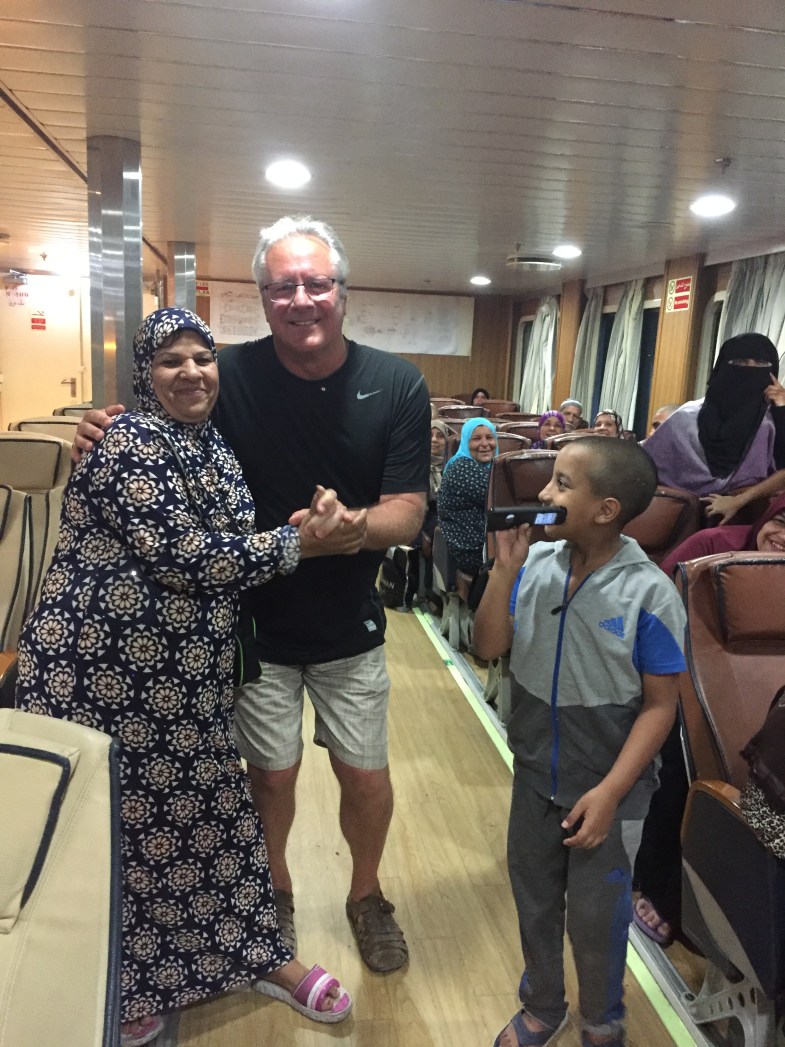
We did have some fun aboard the ferry. Emily was offered 100 camels for her hand in marriage, and I had a hoot with several Muslim women when one of them approached me and, through sign language, said, “I love you.” The women wore hijabs and niqabs, and they all laughed at the antics. We all had a great time! It was really heartwarming and fun.