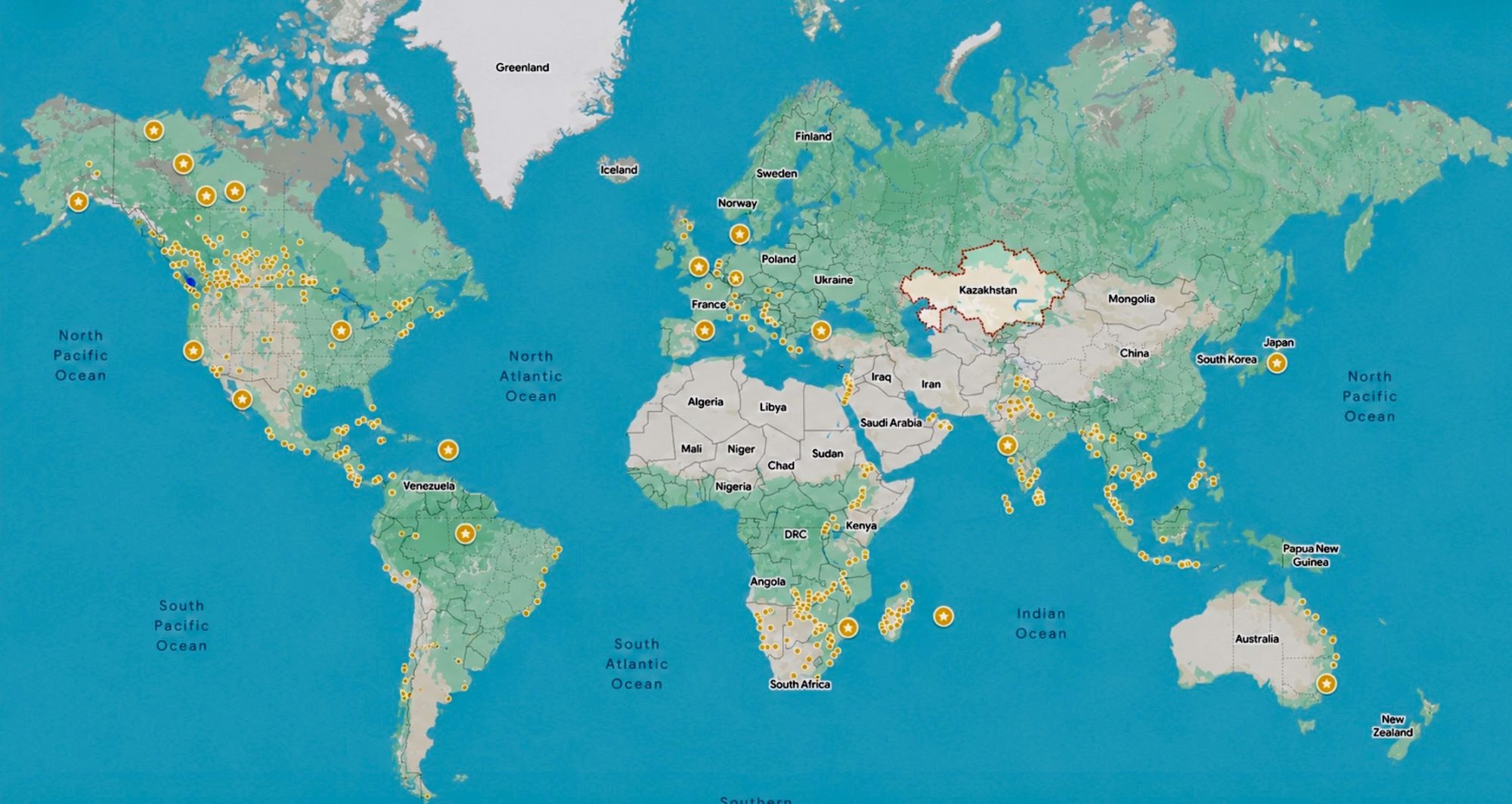
We’re in Zambia now and, in hindsight, knowing that cell coverage and Wi-Fi availability would be sketchy, we should have provided a little route information in our first post.
But when we were sitting outside in Johannesburg, the wind was howling, it was close to freezing and the internet was slow, so we tended to keep things short. We’ll start at the beginning…
After a total of 29 hours of travel, 23 hours flying, we arrived in Johannesburg and were met by a nice fellow named Resistance, who proceeded to take us to our accommodation.
We spent our first three nights at a great lodge, Safari Club SA, located near O.R. Tambo Airport. We were warmly greeted by the hotel owners, Jose (sp?) and Alastair MacDougall. The lodge is set in beautifully manicured surroundings, with a nice, welcoming sitting area and restaurant and a separate indoor-outdoor bar.
Our room was cozy, with a comfortable bed and spacious bathroom. Over the next three days, we enjoyed excellent breakfasts and dinners, but more importantly, we shared great conversation with Jose and Alastair. They are a lovely couple who put their hearts and souls into their business.
We highly recommend Safari Club SA, and we are looking forward to stopping in for a visit when we return to Joburg in early September.

The pool

Outside bar area

Dining area

Lounge
To date, we’ve covered just under 2,000 km and have so far camped in the bush for six nights in three locations, stayed at a nice little lodge just outside Francistown for one night, camped for two nights at Nata Lodge campsite in the North-East District of Botswana near the Nata Bird Sanctuary and Sowa Pan, and spent two nights in a beautiful bungalow at Wildtrack Safaris-Eco Lodge, situated in the centre of the newly formed Kavango-Zambezi Transfrontier Conservation Area—the largest of its kind in the world.
Departing Wildtrack on the 31st, we made our way to the Kazungula border crossing. After two hours of the most bizarre, red-tape-infested customs process, we crossed the Zambezi River from Botswana to Zambia and made our way to Livingstone for two nights, where we regrouped, picked up a SIM card and loaded up on groceries for our next leg through the wilds of Zambia.

July 20 to 22, Blouberg Nature Reserve

We started off heading northeast towards the borders of South Africa, Zimbabwe and Botswana, driving approximately 430 km, and arriving at Blouberg Nature Reserve in the lowveld of Limpopo Province. We had a nice campsite located in a very dry and dusty bushveld.
Blouberg Nature Reserve harbours the biggest breeding colony of Cape vultures in the world and hosts more than 1,000 breeding pairs. We were hoping to see them.
Getting to the reserve was a little bit of a challenge, as our Garmin GPS told us to leave our vehicle and walk to our destination.
We figured it out. We had passed the turnoff.
In Joburg, we had to resort to Google Maps to find our hotel after picking up our truck. Our Garmin GPS didn’t help us.
We were told to turn left into a farmer’s field when we were looking for Woodlands and were told to turn left or right or straight or some other bloody thing several other times.
When we last visited Africa, we used maps. We were told GPS can get you lost. Well, whoever told us that was right, so now we travel praying to the powers that be that we are, in fact, going in the right direction and not towards Antarctica or Bolivia or some other place that is not remotely close to where we want to go.
July 22 to 24, Mapungubwe National Park, Mazhou Campsite

Continuing about 150 km north, our next stop was Mapungubwe National Park. The park is in South Africa and is located near and along the Limpopo River and the borders of Botswana and Zimbabwe.
The park is split in half, with the Eastern and Western sections separated by farmland. The campsite is partially fenced, primarily to keep out elephants, but monkeys, baboons and nyala roam freely around the site.
The nyala are small to mid-sized and are very similar to white-tailed deer. They are habituated and would literally walk up to you and sniff and lick your hands with the expectation of food. This is great, but unfortunately, they have become this way because, without a doubt, people feed them. Not a good thing.
Every evening at sunset, two bush babies would leap effortlessly through the trees surrounding our site. The distance they can leap is quite amazing, and they do so without any sound whatsoever. We didn’t get any pictures of them, but we did a little farther along in our travels.
Before we arrived at our camp, we picked up groceries at a Choppies grocery store. Near the checkout, they had a CFC stand—Choppies Fried Chicken. It looked great, so we figured we would be lazy on our first night at the campsite.
We were very happy we did this, as the four bundles of firewood we purchased at the park gate might as well have been wet noodles. It was impossible to start a fire—more like a smudge—so our CFC chicken came in very handy that evening.

A visit just beyond the elephant wire

Chasing cattle back to Zimbabwe

Lilac Breasted Roller

The local residents

Just stopped in for sniff

Cape vultures

Slaving away

Chops, squash, beer and wine
July 24 to 26, Tuli Wilderness, Tuli Block, Botswana, Molema Campsite

About 65 km from Mapungubwe, we passed through the Pont Drift border crossing to the Tuli Block in Botswana, where Molema Camp offered an unfenced wild experience.
To our surprise and delight, all five sites had a little toilet, open-air shower and dishwashing station, complete with hot water. Rustic, but a luxury for sure, because elephants, lions and leopards can frequently stop by for a visit.
Walking to the ablution block—toilets—in the pitch black with only a headlamp or flashlight can kind of raise the hair on the back of your neck a little.
Camping near us were two German couples with whom we shared a morning game drive, but it was the evening before that the excitement really kicked in. It was dark, and I was in the process of searing and charring our peri-peri chicken.
The evening was quiet and relaxed when, all of a sudden, four bright headlamps were pointing our way and quickly moving towards us. Through the darkness, the Germans were running towards us, pots full of rice and chili con carne in hand.
Elephants! Elephants had invaded our campsite! We had no choice but to run!
The minutes turned into about an hour, so we offered them some bowls and utensils, and we proceeded to chow down, all the while keeping our lights and my super-duper 1,000-lumen flashlight pointed towards their camp.
As the ruckus at their campsite settled down, all of a sudden, we heard noises behind and to the side of our site. Oh-oh, more elephants!
We all stood, watched and shone our lights, waiting in anticipation for the next invasion. Fortunately—or not; it all depends on whether you like this kind of action, and we do—the beasts, the elephants, ha ha, dispersed, and we were able to wish our visitors a good night.
Joyce and I sat looking at the incredible night sky, listening for any further visitors, but none arrived. Off to bed we went, hoping we would have another encounter tomorrow, but alas, it was not to be.

Our abode

Sunrise in the Tuli wilderness

Two week old Black Eagle

Two week old black Eagle

Waiting for us after our hike

Wildabeast

Male Kudu

Yum, sausage and beans

Slightly well done Peri Peri chicken
At this point in time, I was really getting into building fires and cooking on the braai over the embers. I chopped wood, collected kindling and used my bare hands to move burning logs and place them exactly where they needed to be. I need to come up with a better way of moving burning logs!

July 26 to 27, Francistown, Woodlands Stopover Lodge

Located just outside Francistown and about 170 km from Tuli, Woodlands was a bit of a surprise. We were expecting a lodge complete with a little restaurant and maybe a bar with good Wi-Fi so we could upload some pics and get the blog updated.
Well, this wasn’t really a “lodge,” just a reception office that sold some frozen lasagne, soups, bread and stuff, beer (yes!), and red or sparkling white wine.
Our lodging was surprisingly beautiful, with a comfortable bed, a microwave for heating our frozen lasagne and a nice bathroom with a rain shower and lots of hot water. Joyce was in heaven, as she could wash and dry her hair and rid her body of the dust and grime that had accumulated.
There were two rooms side by side, and as we were unwinding with a cool drink and doing some tech catch-up, our neighbours arrived.
Christian and Nishi (sp?) are a wonderful couple from Norway who had taken a year off to travel. We immediately hit it off and spent the remaining afternoon and evening chatting about whatever subject came to mind.
Nishi suggested we share dinner with them, so while she cooked up a dish of rice and eggplant spiced with chilies, we nuked our lasagne. We sat down, shared our dinners and sipped our drinks into the wee hours of the night.
Well, actually, until around 9:00 pm, which seems to be bedtime for most of us older travellers.
July 27 to 29, Nata Lodge Campsite

Located just off the main A3 highway, approximately 170 km northwest of Francistown, the lodge offers bungalows, permanent tent sites and a very sandy and confusing campsite.
There were too many lights around the sites, so we had to keep most of our screens zipped up. We were located near a dishwashing station, which also served as a security guard station. It was a little bothersome having a guy sitting at the station constantly looking over at us.
To add to that, his buddies would show up in the evening, and they would chat and shoot the breeze while we were hoping for a little privacy.
We spent two nights here, but this would have been a better place to just break up the journey and spend one night. The site is located near the Nata Bird Sanctuary, which sits on the edge of Sowa Pan.
In the wet season, thousands of flamingos gather, and a very large variety of birdlife can be viewed. Being in the dry season, there was really not much to see, so we spent the day dealing with slow internet. Low on supplies, we had a nice chicken schnitzel dinner at the lodge.

African Bush Baby

African Bush Baby

Minestrone soup with leftover sausage
July 29 to 31, Wildtrack Safaris-Eco Lodge

Continuing a further 220 km north, we spent two nights at Wildtrack Safaris-Eco Lodge. As mentioned, the lodge is centred in the newly formed Kavango-Zambezi Transfrontier Conservation Area.
This area forms a continuous corridor connecting Chobe National Park and the Sibuyu Forest area of Botswana with Hwange National Park in Zimbabwe, allowing the free movement of wildlife throughout the areas.
The main lodge is spectacular, incorporating a large, beamed thatched roof and hosting an amazing collection of African art. Our bungalow had a thatched roof, a huge bed, a giant soaker tub in the bathroom and an outdoor shower open to the incredible nighttime Botswana sky.
The staff were exceptional, and the food—much of it traditional Botswanan fare—was delicious. The lodge offers morning and late-afternoon game drives, of which we did one afternoon drive.
There had been some recent brush fires in the area, so the wildlife was limited, but we did see plenty of elephants, giraffes, sable, kudu and other game.
All in all, a very nice stop if you are heading south or north. Kudos to Johnathon and Jacques for the obvious effort they have put into managing the lodge, with guest comfort and enjoyment top of mind.

Fire pit overlooking the watering hole

The local watering hole with Warthogs

Bummer

Sunset in the Sibuya Forest

Just a small lunch
July 31 to August 2, Kazungula Border Crossing, Livingstone, Zambia

At our departure, after being treated to several local African songs sung by the staff of Wildtrack, we continued a further 170 km to Livingstone, Zambia.
It is about a 70 km drive to the Kazungula border crossing, where you cross the Zambezi River to either Zambia or Zimbabwe. The customs process at this crossing has got to be the most inefficient, time-consuming process in the world.
Clearing Botswana immigration was a snap. A simple departure form, a stamp and you are on your way to the car ferry—one truck, two pickups capacity.
You drive onto the ferry, pay 200 pula and cross the river. You then drive off to the point of no return: the Zambian side of the river and the awaiting quagmire of trucks, dust, fumes and “agents” swarming to offer their services for the customs chaos that awaits!
After two hours of filling in ledgers asking for engine serial numbers, chassis serial numbers, make, model, colour, engine size, registration information, police clearance papers—which we didn’t have—and passport information for the toll fee, you repeat the same process for Interpol and then again for the road tax. You then proceed to pay the associated fees at several different offices.
Total insanity. When we last crossed this border, it was on foot, so the process was simple.
Below is the first step of many more!

If you enjoy our blog please share.